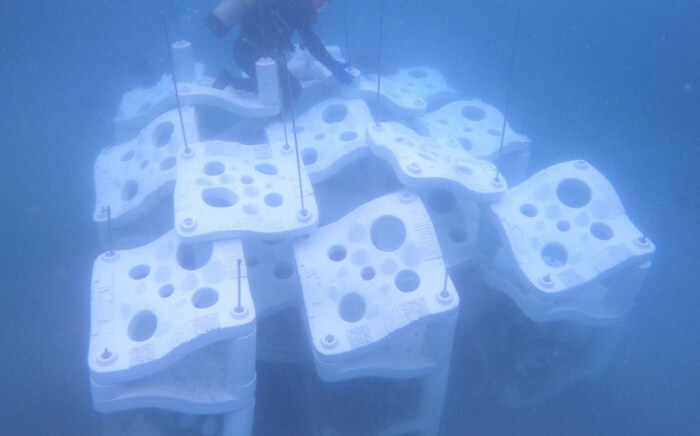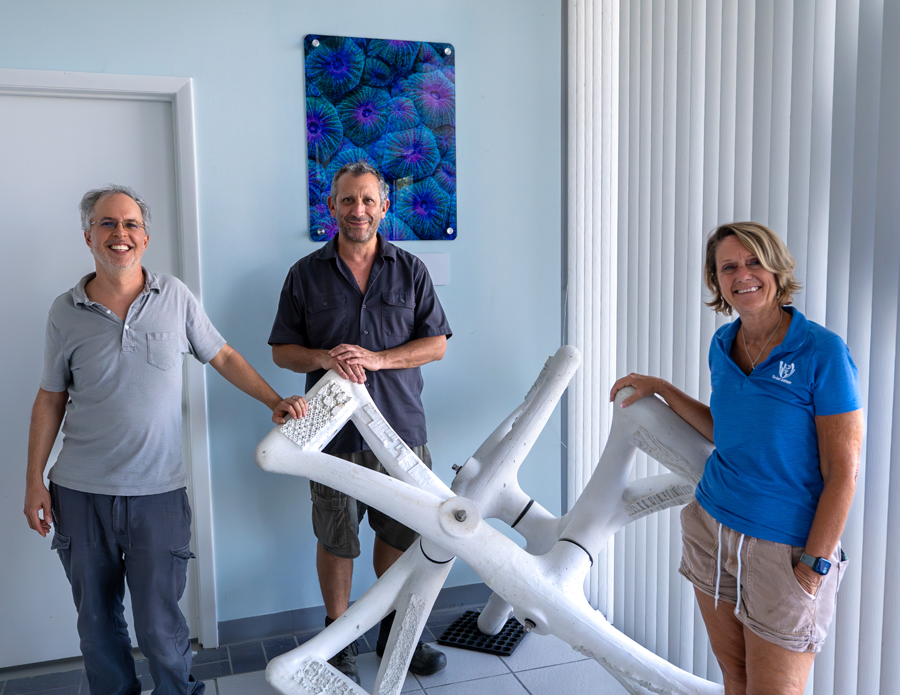
Our latest Marine Living Structures Initiative (MLSI) prototype, MLSI2, is now on display at The Reef Institute in West Palm Beach. As an ongoing effort, MLSI is developing new artificial reef materials, designs, fabrication and deployment systems to optimize marine habitat regeneration and coastal resiliency. These living sculptures not only act as habitat, but form structures that strengthen as they grow, creating new forms of hybrid ‘green gray’ infrastructure that protect coastlines while enhancing local marine ecosystems.
MLSI’s artificial reef structures contain 70% recycled content and are higher in strength, marine durability, and lower in carbon intensity than traditional concrete used for marine infrastructure. MLSI is a collaboration between The Reef Institute (TRI) and Singer Studio. MLSI modules have been deployed around Palm Beach County, Florida and in the Caribbean, and are currently being evaluated for how they support coral recruitment, growth and diversity, as well as supporting the ecosystems corals depend upon.
The prototype for MLSI2 can now be seen in the TRI lobby along with a small installation of the original MLSI Wave Tiles. MLSI2 has been developed over several years with a team of engineers to optimize the structural design for ocean deployment. MLSI2 is now in fabrication with planned deployment in the Caribbean in 2026. The goal is to establish a proof of concept for recycled low-carbon environmentally regenerative artificial reefs that provide coastal protection, and ultimately to influence the materials and design of massive upcoming investments in coastal infrastructure.
This project has been made possible through the generous support of the Jeffrey Cook Charitable Trust, The Max and Victoria Dreyfus Foundation, The National Endowment for the Arts, The Glenn Bailey Foundation, and the Michael Singer Foundation f/k/a the Bermil Foundation. Image credits: Caleb Fix.